How important are information systems to accountants – an academic’s view

Max the Accountant Cat (Photo credit: Found Animals)
Personally, as someone who has implemented and worked with several accounting and business information systems, I would say information systems are vital to accountants. Without them, financial accountants and auditors get no financial statements; without them, managers get no information to make business decisions. But that is the practical me. And I suppose the academic me too. However, if the recent European Accounting Association (EAA) annual conference is anything to go by, the academic community does not share my view. The EAA is a great conference, and brings together about 1,500 academics from all over Europe and beyond. Now, what I am about to say is not at all intended to be negative against the EAA, rather a reflection on the possible lack of focus by accounting academics on the ongoing effects of information systems on accounting and accountants. Of about 900 papers at the 2013 EAA conference in Paris, only 9 were presented under the title “information systems”. I did a quick check to see if papers were not categorised correctly and I only found 2 or 3 papers which I personally might classify as information systems papers.
So what does this mean? I don’t know to be honest. Maybe it’s a temporary blip. Having said that, the previous conferences were not teeming with papers on the things that drive accounting work on a daily basis i.e. information systems. The only thing I can say to my fellow academics is that information systems and technology is not a “black box” any more, it really does affect how we behave and how we do things – think of a smart phone for a moment. Technology does more now that just automate what we as accountants do – it can analyse data better and faster than us and deliver results directly to managers. I don’t think accountants are a redundant commodity yet, but as academics we need more detailed inside the box research to figure out what the accountants of the future will actually do. Well, that’s what I think at least?
FRS102 – a great reference guide

As you may know, non-listed UK and Irish companies are not subject to International Financial Reporting Standards (IFRS). Instead, local standards are applied to financial reporting in such entities. Recently, the FRC in the UK has issues FRS102, which is applicable to all non-listed UK/Irish companies from January 1st 2015. This standard replaces all previous local accounting standards.
Financial reporting is not my speciality, so if you want to read more about FRS 102, Prof Robert Kirk has authored an excellent reference guide for CPA Ireland. You can find the guide at this link: A new era for Irish & UK GAAP – A quick reference guide to FRS102 – CPA Ireland and a hard copy of the book is also available to purchase here.
Accounting – in the eyes of an 8 year old
A few weeks ago, my daughter asked me what exactly is it I do in work. My reply- I teach accounting. Now as, any of you with kids will know it never ends with a single question. So the next question: “What’s accounting?” And I think, damn. Ok, deep breath – how do I explain it. My reply: it’s about finding out how much money you make. Am I out of jail? Of course not. The next question was: how do you make money? Can you not just print more?. So, I ignore the second question as I don’t teach economics. My reply: you make money by selling something for more money that you bought it for. So the next question came back – can you always do that and make money? My reply: no. Next came a rhetorical question: well why do you need accounting then? If you don’t always make money, you don’t need accounting as you said accounting only tells you how much money you make.
Young minds – the clarity they have sometimes!
An effective internal auditor: key attributes
An internal auditor is someone who checks the internal control systems in an organisation – usually larger organisations. Staff typically fear the arrival of an external auditor, but at least they go away in a few weeks. The internal auditor is not only ever present, but knows a lot more about a business than any external person. Thus, in my own experience, internal auditors are perhaps less liked than external auditors. However, perhaps my experience was just a bad one. This articles from CGMA at least suggests that an internal auditor needs some decent communication and social skills to0.

(Image from CGMA)
The effective internal auditor: 7 key attributes.
Accounting standard setters can’t agree
I don’t normally write too much about complex accounting standards and I’m not starting now, but this blog post from The Economist caught my attention. I would have thought the term standard might have helped these guys figure out a “standard” approach.
Ireland’s low corporate tax rate – good or bad?

(Photo credit: Wikipedia)
I wrote this post as a guest post for my fellow blogger Mark Holtzman (see accountinator.com)
Many of you are probably familiar with Ireland’s low rate of corporation tax – 12.5%. It has been the subject of many articles and much criticism over the years and in recent times – articles including companies such as Google and Facebook and terms such as “the Dutch sandwich”. So, for the benefit of anyone outside Ireland, let me try to explain a few things and give my opinion for what it is worth. By the way, I am no tax expert.
Ireland is a small island with little or no natural resources – except our scenery and Guinness perhaps. As a result, we have never had any serious indigenous manufacturing. Thus, at some point in the 1970’s a 10% corporate tax rate on manufacturing was introduced. All other businesses paid a higher rate, which I think was 33%. I remember learning tax in college and with this difference in rates, some companies stretched the definition of manufacturing. There was one case I recall which involved determining whether or not banana ripening was manufacturing. The courts ruled in was and since then, is the largest banana exporter in Europe. It’s true, and no banana republic jokes ! The outcome of this case resulted in a large infrastructure being developed in the country for banana ripening.
Now, our corporate tax rate is 12.5 % for all business. So we cannot say Ireland is a tax haven – as all companies are treated the same. But it is fair to say we are a low tax economy. Our European neighbours (Germany in particular) complain, and there are many reports on large US companies avoiding US taxes by being based in Ireland or using Ireland’s low tax rates to transfer profits through Ireland. So is this good or bad? Well, there is no correct answer to this, and of course the answer depends on your perspective. From my perspective as an Irish person and accountant, it is good – jobs are created, more taxes are brought in than if the rate were higher for example. The German government don’t seem to like our low tax rate – their rate is higher apparently – and there are rumblings to have a more common Europe wide tax rate.
But are low tax rates good? Perhaps they can be. Last year when our government was preparing its budget one economist showed that and 11% rate of value-added tax (like a sales tax) would yield the budget deficit. The current VAT rates are 23%, 13.5%, 9% and 0%. – depending on the type of good or service. If all this was replaced with a single 11% rate, an annual additional intake of €1.5 billion would occur assuming demand was stable. Another idea on low tax rates is that if the rate is lower, more people will pay – or put it another way, less will avoid it. In the 1980’s our income tax rate topped 60%. Small business in particular hid money in off-shore accounts. By the early 1990’s, the top rate had decreased to 48% (now 41%). The tax authorities had a tax amnesty, whereby heavy penalties and interest were waived on the off-shore monies. This, and the lower tax rate, brought many thousands of people into the tax net. And as the tax rate has stayed lower than previous times, these businesses have by and large stayed in the tax net and the black economy is less than previous.
A final point when comparing tax rates is what do we mean by tax. For example, all businesses in Ireland pay very expensive rates to the local council/municipal authority. In other countries, this is much less. For example, certain German states keep their local taxes low to attract investment. So before comparing headlines tax rates, we have to ask are we comparing apples with apples. As any management accounting student knows, we cannot compare figures which are not comparable as a basis for decision-making.
I hope you find these thoughts useful. I have included some links below which may be relevant.
Related articles
- Editorial: Cut corporate taxes to bring business back (ocregister.com)
- Be Glad You’re Not Living in One of the Those Terrible High-Tax Countries (irishleftreview.org)
- U.S. Tax Rates Are Really Low (washingtonmonthly.com)
- Insight: In Europe’s tax race, it’s the base, not the rate, that counts (Reuters) (newsdaily.com)
US Postal Service – reduced volumes = reduced costs

(Photo credit: Wikipedia)
In February this year, the United States Postal Service (USPS) decided to cease delivering mail on Saturdays. While this may be seen as inconvenient for some personal and business users, in management accounting terms it is probably a simple cost-volume issue.
Mail volumes have fallen globally due to email and other communications media. With falling volumes, a postal service would either have to reduce costs or increase revenues to maintain profits – or keep state subsidies low. Increasing revenues may be difficult given the competition is sectors such as parcel deliveries, which have increased in volumes. It is also difficult to raise postage rates given the political and/or state involvement. So this leave costs, or more specifically cost-cuts, to get things back in balance. Apparently, ceasing Saturday deliveries will save $2 billion annually. You can read more here from The Economist
Currency devaluations – the effects on assets

Devaluation (Photo credit: ervega)
It is not that often that we as accountants face the problem of currency devaluations. We would have to be an accountant in a large global firm who has assets denominated in a foreign currency that is devalued. You know I am a management accountant, so I will leave the complex accounting standards up to the experts. In other words, I avoid the complex issues here.
Last February, the Venezuelan Bolivar was devalued by about 30%. The exchange rate was moved from 4.3 bolivars to one US dollar to 6.3 bolivars. So for example, if a company had assets worth 430,000 bolivars or $100,000, the value of these in $ terms is now $68,253 (4.3/6.3 x 100,000). As Venezuela has many foreign investing companies, the balance sheet of these have been hit a little. For example, Irish paper and packaging company Smurfit Kappa saw its asset values fall by €142m – see here
Cost overruns on projects
Here is a great infographic from the February edition of CIMA’s Financial Management. A few Irish projects in there. I think we’re better nowadays, but I may stand corrected on that.
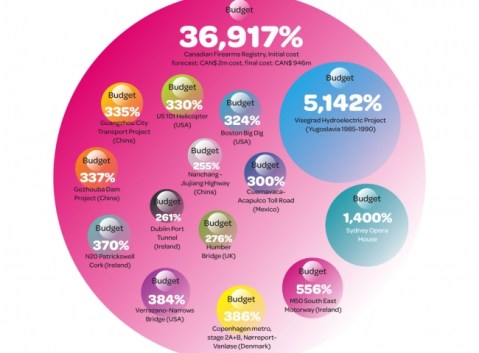
Read the full article at this link:
15 of the world’s biggest cost overrun projects | CIMA Financial Management Magazine.
Setting up business
A great analogy for a new business

 While out for an early morning walk, I glanced upon a popular San Francisco community garden.
It was tranquil, peaceful — and surprisingly well-organized.
It was small so many of the gardeners found ways to maximize their space, using careful planning, creativity (and a little muscle.)
Your businesses can benefit by being equally ingenuous. Develop your own small business “green thumb” and get “more for less” by using creative, economical ways to attract, convert, and retain your prospects and customers.
Cultivating Your Business Idea into a “Sales Generating Garden”
1. Choosing the right kind of plants for you (Your “Aha” Moment): Okay, so you’ve got an idea. But is it enough to support a viable business or product — able to solve the problems faced by your potential customers? Your ability to sell (and ultimately, make money) is based on your idea’s attractiveness to potential customers.
2. Planting…
View original post 329 more words
Money in Formula 1
Following from my last post, I done a little digging around and found a great article in Forbes about the money and brand valuations in the Formula 1 business. Red Bull may the new and hip brand, but Ferrari is viewed as the most valuable. Have a read here

Money in football
A short post today. I am not a big football fan, but when you think of the amounts of money top football clubs earn and spend, it’s big business. The Economist published a great infographic and few months ago which show the revenues if the top European teams. Very interesting – you can see it here

London Underground – profitability and costs in the early days

London underground (Photo credit: @Doug88888)
I have been reading a book recently on the history of the London Underground. It’s called Underground to Anywhere by Stephen Halliday and I actually bought it in the London Transport museum, on Covent Garden. Of course the tube is 150 years old this year, and you will find more about that here.
Reading the book I was quite surprised by how much accounting was in there. Two things stand out from the early days of the tube which related to accounting. First, the financing seemed to be quite precarious. As each line was built by private companies, private finance was raised. And when results proved less than expected, it seems quite a bit of creative re-financing went on. The author actually notes that without the somewhat suspect and complex financing, London’s Underground may not have grown to what it is today.
The second thing was the fares structure in the early days. Before lines were connected, the fares seemed to have been standard at say 2 pence. However, the author notes that the various companies started to raise and lower fares and certain times, or lower fares overall to increase passengers numbers and revenue- a classic cost, volume profit (CVP) scenario.
Fraud at Olympus
Internal controls and fraud are not really an area that I write a lot on. Just before Christmas I read this article from CIMA about fraud at Japanese firm Olympus. It includes interviews with Michael Woodward, who was at the heart of putting things right. The are a lot of issues in the article and it is worth a read.


 Martin's accounting blog