What is lean accounting?
Defining lean accounting is a bit odd to me, as I don’t really buy the idea that there is a technique called “lean accounting”. Having said that, there is definitely a concept called lean manufacturing. In a nutshell, lean manufacturing implies three concepts – pull, flow and waste reduction. Pull means product is produced (or pulled) according to customer demand. Flow means product moves through a facility as efficiently as possible and no delays. Both of these should imply waste reduction.
So what does this mean for accounting. Well one thing is inventory reduction. Another may be capital investment to get things working well. Both might put accountants off! But rather than me rattle on, here is a very nice article from Forbes which explains lean accounting and some issues.
Accounting and public services
Accounting and accounting information is used for many purposes. Even the public sector immune to accounting information, and accounting-based controls. Recently (March 4th, 2014), BBC Radio 4 broadcast a very interesting programme (The Accountant Kings) on accounting in the provision of public services in the United Kingdom. Here is a link to the series website http://www.bbc.co.uk/podcasts/series/fileon4, and the podcast itself can be found at http://downloads.bbc.co.uk/podcasts/radio4/fileon4/fileon4_20140304-2050c.mp3.
The costs we don’t capture
Image from wikipedia
I recently attended the 11th ACMAR conference in WHU, Vallendar, Germany. A presenter was reminding us of how we often forget about opportunity costs. This made me think of a recent hotel reservation I made, and how many costs go unrecorded.
I had booked a hotel in Montreal for a few days in April. The hotel emailed me to say that a due to a refurbishment programme, they would not open until May – a delay of 4 weeks. The Canadian winter delayed the refurbishment work it seemed. I was offered alternative accommodation, which was fine.
There is of course a loss of revenue to the hotel use to the delay. I would guess that the cost of lost revenue was included as part of the refurbishment, but I wonder will the revenue lost due to the delay ever be recorded or noted. Somehow I doubt it. Either way, such “costs” never make it to the accounting records.
Overhead accounting error
Image from wikipedia
As I have written in a previous post, when error are discovered in financial statements, these errors should be corrected at the next available opportunity. This can mean re-stating published accounts. What to do is governed by IAS 8 — Accounting Policies, Changes in Accounting Estimates and Errors.
Finding examples of errors in published accounts for example or teaching purposes is not always that easy. In March 2014, Bloomberg reported an error in the financial statements of SolarCity, a large US solar energy company. The company made an error in how overhead costs were allocated between cost of sales and other expenses it seems. While overall profits/costs were not affected, the cost of sales figure increased by about $20m per annum for 2012 and 2013. You can read the full article here.
Promotions on price
As a management accountant, when price is dropped we probably want to be sure that we still make a profit- or at least cover cost. An article I found on inc.com gives some very useful hints to ensure that price promotion is effective in the longer term. Your can read is at this link.

Non-financial performance measures – example of one difficulty from Deutsche Bahn

According to a report in Der Spiegel, German rail company Deutsche Bahn has had quite an increase in the volume of customer complaints last year (2013). Complaints reached a new record in fact and were 50% higher than previous years.
For a rail company, customer complaints are probably one key non-financial performance measure. Ideally, the complaints should be as low as possible and I am sure a there’s a target in Deutsche Bahn on this measure. Reading the report though, it’s easy to see why using non-financial performance metrics can be tricky. Apparently the increase is down to ow things. First, more complaints arose due to poor weather – something beyond anyone’s control. And second, a new system for customers made it easier to complain. So, a simple year on year comparison of customer complaints would be quite useless. Maybe even setting a target is tricky too, as weather, strikes and many other non-controllable factors could come into play.
Despite such difficulties with non-financial measures, they will always augment monetary measures. While money is typically quite a stable measure , it can’t capture qualitative factors like customer satisfaction.
Operating leverage – seasonal woes at UPS & Fedex
Apparently, logistics firms UPS and Fedex ran into a bit of bother during the pre-Christmas parcel rush – see this article on Forbes by Steve Banker.
The problem may be one of bad planning. Simply put, Steve Banker suggests both firms did not have enough capacity in terms of aircraft or parcel sorting at their highly automated distribution centres. While Banker talks about strategic planning, when I read his article I immediately thought about operating leverage – which would of course be part of the strategic planning.
Operating leverage can be simply defined as the percentage of fixed costs compared to total costs. If UPS or Fedex wants to add capacity, by either leasing aircraft or adding more automation, this will increase fixed costs and operating leverage worsens as these fixed costs affect profits. Alternatively, firms like UPS or Fedex could instead hire more temporary staff, which represents a variable cost. No doubt they do this, but from my limited knowledge it would seem Amazon have this well organised. Increasing variable costs does not affect operating leverage, and is thus preferable in the longer term.
Of course it may be that firms like UPS and Fedex actually need to increase capacity and thus fixed costs. But as Banker points out in the Forbes article, investing to cover short term seasonal capacity issues implies over or idle capacity at other times.

A management accounting system – in a police car!
More and more, technology is used to help many of us do our job. I read an article a few months in the Wall Street Journal about how increasing integration of technology in NYPD police cars is helping officers fight crime. Of course, in-car systems are not confined to NYPD, and many European police forces use technology in patrol cars.
The article mentions a smart car, which is being trialed in one NYPD precinct. The car is equipped with number plate recognition, video cameras and even radiation detectors. All data collected is transmitted back to a central location, where it can be analysed at a high level if needed. The technology also allows officers make decisions while on patrol – for example, ignore a car with an outstanding parking ticket, but stop if if stolen.
So, where is the management accounting system is this police car? Ok, this is a trial, but it is likely to reflect what an actual patrol car will do in the near future. I define management accounting as the provision of information to make decisions. Using this simple definition, there are two ways we could describe the smart patrol car as part of a management accounting system 1) it provides officers with information to make decisions on the spot and 2) the information gathered may also be used to inform higher-level policy and strategic decisions.

The AK 47 – a good example of production and cost standards
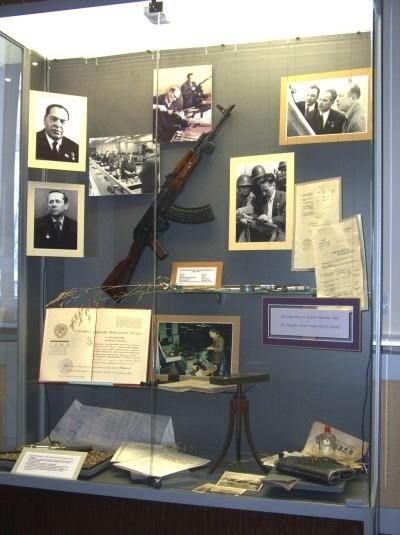
(Photo from Kalashnikov Muesum)
On December 23 last, Mikhail Kalashnikov the designer of the infamous AK 47 machine rifle died. I had some thoughts about the AK 47 which led me to write this post. But before I convey my thoughts, let me say that I am not trying to glorify one of the world’s most lethal assault weapons, nor do I condone violence.
As a child who grew up in Ireland, I knew at a young age what a Kalashnikov was. In the 1980’s it was the favoured weapon of the IRA and I had seen images of it on TV news reports. I also remember the news reports saying it was favoured for its simplicity and ease of repair.
So, when Kalashnikov died last year, I started thinking about how the AK 47 was made. It has been made (with a few variants, such as the lower cost AKM) since 1947, and is still in production. It has a simple gas mechanism, few parts and lots of space between the parts.
The manufacture is thus relatively simple, and as it seems to have not changed much since the 1940’s, this may be one of the best examples I could think of in terms of standards as used in standard costing. With 70 years of production history, I would guess that there are standard times for assembly of the various components of the AK 47. And, production planning based on such a long experience of making pretty much the same thing is likely to be quiet simple. Simple design, standard times and good planning of course contribute to lower cost – and my reading around on the AK 47 has revealed that keeping costs down was one design goal. So, I guess it comes as no surprise with its efficient design and production, that the AK 47 is cited as a weapon responsible for more deaths than any other. Not the main point if this article of course, but I hope you get the link to standard costing techniques.
Here’s a good related article from The Economist.
Artificial intelligence in Accounting

In the latter part of 2013, I noticed several new developments in cloud accounting software. I suppose one of the key advantages of cloud accounting software is that it allows the software provider to concentrate on what they do well, while at the same time allow other software providers to integrate with their products. And, some of these products include some level of artificial intelligence.
To give an example of a non-cloud product first, Irish firm OCRex use optical character recognition to help accounting practices do bank reconciliations when smaller clients don’t do this – see http://www.ocrex.com/home. This software reads scanned bank statements and reconciles opening and closing closing balances, and leaving the accountant with the job of checking for missing items only. Thus, this product is intelligent in that it matches items on the bank statement using amounts and other information like to a reference.
Now let’s take this idea to the cloud. Several accounting software products can now scan emails., faxes and scanned documents to determine not only the amount of a business transaction, but also determine what kind of transaction it is. For example, xero software offers an add-on which reads transactions and posts automatically to the correct expense account. From my understanding of the xero add-on, it also learns as it goes, learning what supplier is posted to which expenses account etc. This certainly has a lot of potential for small businesses, reducing processing time and storing documents in the cloud.
What is the margin on the Apple iPhone 5S and 5C?
This is a question I often asked, well about all iPhone models since my iPhone 3. Below is a link to a post by Wendy Tietz which includes good estimates. It is set out like a student exercise too, so give it a go if you have the time. Seems Apple make quite a margin, and it seem the mobile operators subsidise quite a bit too.
Non-finance experience essential for finance leaders
A short article in CIMA’s Insight e-zine caught my attention recently. I have written posts before on the non-accounting skills accountants need – such as good communication skills and technology skills.
This CIMA article also notes the importance of skills and experience in other areas for finance staff/management accountants who want to climb the career ladder to become finance leaders or directors. 69% of finance directors surveyed by a recruitment firm reported the need to learn and understand the business operations. I could not agree more. My own experience as a management accountant really did not blossom until I learned the basics of how production planning in the factory where I worked. With this to hand, it was much easier to make the link between what happened on the floor and how money was made or lost.
The article also notes that students should apply theoretical knowledge as soon as possible. Again, I could not agree more. Setting up a standard costing system in the same factory as above really helped me understand what I learned, but also appreciate that textbooks do not teach you everything. For example, it was easy to set machine running standards as the machine suppliers had a wealth of experience and could easily tell you how many units an hour could be produced under varying conditions.
The full articles is worth a read – see here Non-finance experience essential for budding finance leaders.
Building a better income statement – according to McKinsey
McKinsey have a nice web article which highlights the problems with GAAP reporting versus the needs of investors and analysts. The kernel of their article is that financial statements, with some small adjustments, could save investors a lot of re-working of figures. They provide the following example:

Image copyright McKinsey
Two things come to my mind. First, in my first real management accounting job almost 20 years ago now, we prepared an income statement which was not too far away from the one on the right above. And, most management accounting courses would teach students to draw up some kind so similar profit statement – at least separating direct and indirect costs.
Second, the articles does not mention XBRL at all. With tagged data from GAAP financial statements, XBRL could re-draw financial statements in any format. I am not saying all XBRL tags are there to do what McKinsey suggest, but it is certainly possible technically.
You can read the full article at the link below. It is worth a read.
The cost of my time…
In November last year I wrote about hidden costs. You may have seen this story below doing the rounds in the internet. It made me stop to think for a while – a hidden cost of work perhaps!
“A man came home from work late, tired and irritated, to find his 5-year old son waiting for him at the door.
SON: ‘Daddy, may I ask you a question?’
DAD: ‘Yeah sure, what it is?’ replied the man.
SON: ‘Daddy, how much do you make an hour?’
DAD: ‘That’s none of your business. Why do you ask such a thing?’ the man said angrily.
SON: ‘I just want to know. Please tell me, how much do you make an hour?’
DAD: ‘If you must know, I make $50 an hour.’
SON: ‘Oh,’ the little boy replied, with his head down.
SON: ‘May I please borrow $25?’
The father was furious, ‘If the only reason you asked that is so you can borrow some money to buy a silly toy or some other nonsense, then you march yourself straight to your room and go to bed. Think about why you are being so selfish. I don’t work hard everyday for such childish frivolities.’ The little boy quietly went to his room and shut the door.
The man sat down and started to get even angrier about the little boy’s questions. How dare he ask such questions only to get some money?After about an hour or so, the man had calmed down and started to think:Maybe there was something he really needed to buy with that $25.00 and he really didn’t ask for money very often The man went to the door of the little boy’s room and opened the door.
‘Are you asleep, son?’ He asked.
‘No daddy, I’m awake,’ replied the boy.
‘I’ve been thinking, maybe I was too hard on you earlier’ said the man. ‘It’s been a long day and I took out my aggravation on you. Here’s the $25 you asked for.’
The little boy sat straight up, smiling. ‘Oh, thank you daddy!’ he yelled. Then, reaching under his pillow he pulled out some crumpled up bills. The man saw that the boy already had money and started to get angry again.The little boy slowly counted out his money, and then looked up at his father. ‘Why do you want more money if you already have some?’ the father grumbled. ‘Because I didn’t have enough, but now I do,’ the little boy replied. ‘Daddy, I have $50 now. Can I buy an hour of your time? Please come home early tomorrow. I would like to have dinner with you.’ The father was crushed. He put his arms around his little son, and he begged for his forgiveness.”
Stick to the cooking – restauranteurs and accounting knowledge?

Cuisine 3 etoiles de Jacques Lameloise (Photo credit: Wikipedia)
In October of this year, Michelin star chef Derry Clarke had a go at Dublin restaurants selling “cheap meals” – see here. I guess Clarke was thinking from his own view when he said “the number of restaurants offering meal deals at economically non-viable prices just isn’t sustainable, it’s the same cost in McDonalds, but we have all of the overheads”.
He may have a point about the number of restaurants being sustainable, but Derry, stick to the cooking. Any management accountant could figure out that even if meals are sold cheap (and I doubt they are below cost as Clarke suggests), they still make a contribution towards overhead costs. It would be better to have 50 guests in a restaurant earning a contribution of €5 a head (€250 in total) than having an empty restaurant. In the latter case, costs such as labour, heating, rent and so on are still incurred.


 Martin's accounting blog