Some insights from IAG
 IAG, or the International Airlines Group, is the the parent of Aer Lingus, British Airways and Iberia. In my university, we were lucky enough to have their CEO, Willie Walsh, speak to us before Christmas.
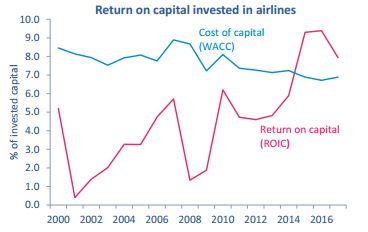
Some things he mentioned are relevant to this blog, and of course interesting. One thing Mr Walsh noted was how only in recent years has the airline sector actually made a return on capital. This must be attributable in some way to a focus on cost by the sector in recent years. The chart below from IATA shows what I mean. As you can see, the cost of capital was higher than the return until 2014.
As my last post indicated, a focus on cost and efficiency has been a feature of the airline sector in recent years. To give another example, Mr Walsh cited an example of using two larger aircraft on a route without a loss in passenger capacity. So fuel, crew and capital cost all decrease in such a scenario. In addition, it freed up a slot at London’s Heathrow airport, which can then be used to generate more revenues.
Unbundling costs at low cost airlines
A few weeks ago, I read a nice article in The Telegraph by David Millward on one of my favourite topics, airlines and  all things to do with airports – I was born close to Dublin Airport and it was a big part of my growing up.
Anyway, many of us have witnessed the phenomena of low-cost airlines emerge of the last 20-30 years, and as an accountant it’s the constant actions to reduce costs that amaze me. As Millward said in his article, one of the things that airlines have done is unbundle. This means you get the basic fare from origin to destination for as low as possible. If you want more you pay more. This is fine by me, on a shorter flight, but now as longer-haul low-cost carriers appear I am not sure – I have no experience yet, so I dare not say. The low-costs have of course eaten into some of the legacy carrier market, but they have also expanded the market by making flying more accessible. Millward suggests that the low-costs have by now probably stripped out all they can to reduce costs, but the legacy carriers can do more – if they wish. I read another article recently which mentioned how WestJet, a low-cost transatlantic carrier remove the in-flight screens to save 500 kg in weight and thus save fuel. They replaced the screens with a wi-fi system and the BYOD idea – most people have their own device on-board anyway. Surely such simple steps could be taken by any carrier.
Accounting for water usage

Image from wikipedia
In recent years, I have become interested in the broader role and use of accounting in society. In particular, accounting for water has caught my eye and in Ireland it’s been great fun in the past two years or so.
As you may know, one of the things we need in accounting is measurement. In business accounting, it’s relatively easy, as the unit of measurement is rather simple – it’s the unit of currency normally. Currencies are broken into various units – euro and cent for example – and we can use the decimal system easily communicate and measure larger numbers.
In accounting for water, the measurement unit is normally cubic metres, or 1000 litres. To measure (or account) for our water usage, we need a measurement device – a meter. Once a meter is in place, we can see how much water we use and take measures to reduce it if necessary – as water is a precious resource.
In Ireland, there has been much debate about billing for water. A recent (December 2016) expert commission report on domestic water billing has within its remit to explore if metering should occur. This, in my view, was/is a completely daft request. The report itself is full of statistics on water usage – none of which are possible with a meter. For example, it suggests usage on average of 111 litres per person per day or 20.8 cubic metres per person per year. In my own house, we have used on average 11 cubic metres per month for 4 people. Annually this is 33 cubic meters, so we are quite above average. And like any management accounting scenario, now that I have some information (on water usage) I can now take corrective action, or pay extra for my somewhat excessive usage. The latter is the subject of much debate in Ireland of course.


 Martin's accounting blog