Brand valuation standard sets challenge to finance
 CIMA’s Insight e-zine from November 2010 (here) reports on a recent ISO standard which give guidelines on attributing a monetary value to brands. Under international accounting standards (IFRS3 in particular) brands are normally only valued when acquired as part of a new business (i.e. only when bought). According the CIMA piece, the new ISO standard suggests three well-known methods for valuing brands:
- Income approach: the objective of the income approach is to calculate the after-tax, present value of future cash flows attributable to the brand. These cash flows are the difference between the cash flows generated by the business with and without the brand. The standard outlines six key ways of doing this: the price premium, volume premium, income split, multi period excess earnings, incremental cash flow and royalty relief methods.
- Market approach: this methodology compares the brand with comparable transactions, looking at acquisition ratios that can be adjusted to consider the similarity of brand strength, goods and services or economic and legal situation.
- Cost approach: the cost approach calculates the amount invested in creating the brand and the cost of recreating it.
An innovative business idea from a big company
Here’s something I read in The Economist last October. It’s a great example of innovation from the car giant Daimler-Benz
http://www.economist.com/node/17311897?fsrc=fb/wl/ar/daimler
Normally we think as smaller businesses as the innovator type!
An example of a prior year adjustment – IAS10
 International Accounting Standard 10 (IAS10) requires companies to make what is termed a prior year adjustment to its financial statements on a number of grounds. One reason is the discovery of an error of a material nature. Here’s a recent example from TUI Travel, one of Europe’s biggest travel operators. The (London) Independent reported on Oct 22, 2010 how TUI has to write off £117m (above 20% of its current year profits) as a result of errors in pricing systems.
TUI’s website reports the following adjustments:
- A reduction of underlying operating profit for the year ended 30 September 2009 of £42m from £443m to £401m, all of which relates to TUI UK.
- A reduction in opening reserves at 1 October 2008 of £70m, from £2,286m to £2,216m.
- As a result of the two adjustments above the separately disclosed items of £29m announced in the Q3 results will no longer be required.
- A reduction in the underlying earnings per share for the year ended 30 September 2009 of 2.8p from 23.8p to 21.0p.
This is a good example of IAS10 at work.
Why do we need a code of ethics?
 CIMA’s Insight e-zine (October) reported on a new version of CIMA’s code of ethics. According to CIMA, upholding an ethical code can most simply be understood as “doing the right thing when no one is looking.” As an accountants, are you sure you know your right from wrong in the workplace? (corporate fraud profiling shows culprits are most likely to be senior male executives in the finance function).
CIMA’s ethical code (and other professional body codes) is a tool to help guide ethical practice and is revised periodically to reflect changes in the external environment and reinforce the ideal of professional duty. Most codes are principals-based, meaning there are no absolute rules. They are rather a roadmap of a journey. So how is it applied in practice? Management (and other) accountants have a position in society as trusted experts. They have a duty to maintain the highest standards of professionalism in their work, while acting in the public interest, by upholding the code and fundamental principles: in CIMA’s case these are: integrity; objectivity; professional competence and due care; confidentiality and professional behaviour. By not doing so, members can lose their professional standing.
With recent turbulence in the economy and financial markets, the failures of many companies can be traced to ethical breaches. It is no surprise that business ethics are very high in the minds of the public, regulators and governments, and that trust in professionals is at a low point.
As long as people work, ethical dilemmas in the workplace will always be present. Ethical grey areas and demands from misguided, or outright corrupt, peers and bosses remain a challenge to deal with.
A financial dashboard for entrepreneurs?
 I read a post on the “Your the boss” blog on the NYTimes recently [see here] which gave some details about some software called inDinero. It’s one of a number of software solutions out in “the cloud” at the moment. The company got off to a really good start, recently receiving $1m in funding which is not bad for a start-up founded by a 20-year old graduate.
I read a little about the software on the website and was surprised by one of its logos “no more accounting”. I suppose this true to an extent in that inDinero does away with the drudgery of enterjng transactions like sale invoices and so on. How you ask? Well it concentrates on the key thing in any business – cash. The software connects with the business bank accounts and credit card accounts online [US banks only at present it seems] and automatically updates all cash inflows and outflows. So, for an entrepreneur, reports are available daily on the cash situation of a business. Any cash flow issues can be seen pretty quick and managed.
I don’t think it’s true to say that inDinero equals no accounting, as financial accounting is of course still needed for tax authorities and so on. It can export data to MS Excel and common accounting applications like Quickbooks, so this can help with the dull but necessary accounting. But, where the real advantage lies is the simplicity with which information on the cash flows of a business is gathered and reported – and this is just what entrepreneurs need. Remember, CASH IS KING. Let’s hope this or similar products make their way this side of the globe too.
Reading a cash flow statement
 A cash flow statement is a financial statement that describes the sources of cash in a business and how that cash was spent. It does not include non-cash items seen in other financial statements such as depreciation. This makes it useful for determining the short-term viability of a company, particularly liquidity and solvency.
The cash flow statement is similar to the income statement in that it records a company’s performance over a specified period of time – normally a year. A difference is that the income statement also takes into account some non-cash accounting items such as depreciation, accrued expenses and provisions for bad debts. The cash flow statement excludes all non-cash items and shows exactly how much actual cash the a business has generated. Cash flow statements show how companies have performed in managing inflows and outflows of cash. It provides a sharper picture of a company’s ability to pay creditors, and finance growth.
It is possible for a company that is profitable to fail if there isn’t enough cash on hand to pay bills. Comparing the amount of cash generated to outstanding debt, known as the “operating cash flow ratio,” illustrates the company’s ability to service its loans and interest payments.
Unlike the varying treatments on some transactions in accounting , there is little a company can do to manipulate its cash flow. Analysts will look closely at the cash flow statement of any company in order to understand its overall health.
The cash flow statement
Cash flow statements classify cash receipts and payments according to whether they are operating, investing, or financing cash flows. A cash flow statement is divided into sections by these same three functional areas within the business:
• Cash from Operations – this is cash generated from day-to-day business operations.
• Cash from Investing – cash used for investing in assets, as well as the proceeds from the sale of other businesses, equipment, or other non-current assets.
• Cash from Financing – cash paid or received from issuing and borrowing of funds. This section also includes dividends paid – although dividends can be listed under cash from operations.)
• Net Increase or Decrease in Cash – increases in cash from previous year will be written normally, and decreases in cash are typically written in (brackets). The net movement in cash should be the differences between the opening and closing balances on the bank account (as per the balance sheet).
There are two ways to prepare a cash flow statement according to International Accounting Standard (IAS7) – the direct method and the indirect methods. The direct methods means looking at the cash records of the business and classifying according to the headings above (operations, finance and investing, which are specified by IAS7). While the direct methods seems practical, most of the time the indirect method is used. This is because IAS7 only requires a cash flow statement to be produced annually (this does not mean internal cash flow forecasts won’t be needed). The indirect method uses the income statement and balance sheet to extract cash flows. While this takes a bit of work, the information is easily available.
The Economist on Germany, the Ireland bailout, the Euro and all that.
 I don’t normally deal with economics on my blog, but I could not resist this . I should first say that my better half is German, so we have German TV in the house. I seen the news report live on ZDF (a German state channel) a few weeks ago when Angela Merkel suggest that bond-holders must suffer and pay. While my heart agreed, my head (and I’m no finance/economics expert) oh feck, that’s Ireland in the deep stuff. Two weeks later, a ‘German’ bailout. And Merkel and her French counter-part still want some bond-holders to suffer. Fair enough, but as the piece in The Economist says domestic politics needs to be put to one side for the greater good of Europe as a whole – just because Merkel is under pressure at home does not mean the whole of Europe should suffer from the onslaught of the markets. One final point, back in the 1990’s when I was in college, the whole EMU thing was a big part if our economics course. Our lecturer at the time was suspicious of the whole thing. He thought economic and monetary union without political union would fail. I now hear lots in the media about the need for fiscal union. Have the chickens come home to roost!
My latest book “Brilliant Accounting”
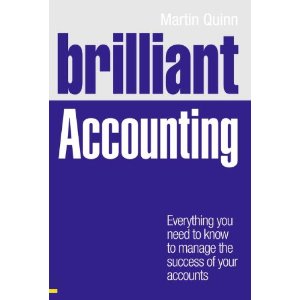 My latest book has just published. Check it out here
Reading a balance sheet
 A balance sheet (or statement of financial position) is an accounting report that provides a snapshot of a business’s position at a given point in time, including its assets, its liabilities and its total or net worth (assets less liabilities). “A balance sheet does not aim to depict ongoing company activities,” wrote Joseph Simini in Balance Sheet Basics for Nonfinancial Managers. “It is not a movie but a freeze-frame. Its purpose is to depict the dollar value of various components of a business at a moment in time.”
Balance sheets are typically presented in a vertical report form. Asset accounts are listed first, with the liability and owners’ equity accounts listed in sequential order directly below the assets. The term “balance sheet” originates from the the fact that the balance sheet is a representation of the accounting equation (assets=liabilities + capital), thus the two totals should balance.
Contents of a balance sheet
Most of the contents of a business’s balance sheet are classified under one of three categories: assets, liabilities, and (owners) equity.
Assets
Assets are items owned by the business, whether fully paid for or not. These items can range from cash to inventories, equipment, patents, and deposits held by other businesses. Assets are further categorized into current assets and non-current assets.
Current assets include cash, accounts receivable, inventories, prepaid expenses, and any other item that could be converted to cash in the normal course of business within one year.
Non-current assets include property,equipment (from office equipment to heavy operating machinery), vehicles, fixtures, and other assets that can reasonably be assumed to have a life expectancy of several years. In practice most non-current assets—excluding land—will lose value over time. This is reflected in accounts through a a process called depreciation. Non-current assets are reported net of depreciation in the balance sheet.
Non-current assets also include intangibles like the value of trademarks, copyrights, and a difficult category known as “goodwill.” When someone buys a company and pays more for it than the worth of its assets, the difference is written into the books of the acquired entity as “goodwill.”
Liabilities
Liabilities are the business’s obligations to other entities as a result of past transactions. Liabilities may be due to employees (salaries), investors ( for loans) or to other companies (who have supplied goods or services). Liabilities are typically divided into two categories: current liabilities and non-current liabilities.
Current Liabilities are due to be paid within a year. These include payments to suppliers, payable taxes and accrued expenses (like wages and salaries). Current liabilities also include the “current” portion of long-term debt payable within the coming year. Non-current liabilities are amounts owed to lenders, mortgage holders, and other creditors payable over more than one year
Equity
Once a business has determined its assets and liabilities, it can then determine (owners’) equity i.e. the book value of the business. Owners’ equity, Or shareholders equity in the case of a limited company, is in essence the company’s net worth.
A balance sheet, if studied closely, can tell the any business owner much about the enterprise’s health. In Balance Sheet for Nonfinancial Managers, for instance, Simini points out that “in a well-run company current assets should be approximately double current liabilities.” He goes on: “By analyzing a succession of balance sheets and income statements, managers and owners can spot both problems and opportunities. Could the company make more profitable use of its assets? Does inventory turnover indicate the most efficient possible use of inventory in sales? How does the company’s administrative expense compare to that of its competition? For the experienced and well-informed reader, then, the balance sheet can be an immensely useful aid in an analysis of the company’s overall financial picture.”
(Some of the material in this post has been adapted from inc.com, the original post can be found here http://www.inc.com/guides/2010/06/how-to-read-a-balance-sheet.html)
Reading an income statement
 This is the first of three posts which give you a quick guide to reading the three key financial statements – the income statement, balance sheet and statement of cash flows. This post deals with the income statement, with the other two coming over the next few weeks.
The Income Statement
An income statement presents the results of a company’s operations for a given period—usually a year. The income statement presents a summary of the revenues, expenses, profit or loss of an entity for the period. This statement is similar to a moving picture of the entity’s operations during the time period specified. Along with the balance sheet and the statement of cash flows, the income statement is one of the primary means of reporting financial performance. The key item listed on the income statement is the profit or loss.
Within the income statement there’s a good bit of information. If you’re knowledgeable about reading financial statements, in a company’s income statement you’ll find information about return on investment, risk, financial flexibility, and operating capabilities.
The current view of the income statement (in line with International Financial Reporting Standards (IFRS)) is that income should reflect all items of profit and loss recognised during the accounting period. The following summary income statement illustrates the format under IAS 1 – Presentation of Financial Statements (image from http://www.accaglobal.com):

This example above is fairly typical of the income statement of a large public company. I’ll explain some items below.
Some terms on the income statement explained
Revenue
According to the IASB’s IAS 18, revenue is defined as “the gross inflow of economic benefits (cash, receivables, other assets) arising from the ordinary operating activities of an entity (such as sales of goods, sales of services, interest, royalties, and dividends)”. This means that revenue is typically the figure for sales of goods or provision of services for the period of the income statement.
Cost of sales.
The cost of sales figure includes all expenses incurred in buying to making the product or service which generates revenue.
Other Income
This is income from sources like interest or investment income.
Expenses
Expenses are classified as either distribution cost, administrative expenses, other expenses or finance costs. No further detail is needed.
Share of profit of associates
This figure is the share of the profits made in an associate company – one where 20-49% is owned by the company (or group of companies) the income statement is prepared for.
The final item in the example above represents a loss made in a section of a business which is discontinued. This separate disclosure is required by accounting standards. Additionally, IAS1 also requires a short statement of comprehensive income, which shows unrealised gains (like unrealised asset revaluations, or currency gains/loses on translation). I don’t include it here, but it is usually no more than a few lines.
Self financing your business

Here’s an article from inc.com (7 Easy Steps to Bootstrapping Success) which give some good ideas on self-financing a business venture. Some useful advice seen as banks are not too generous with start-up financing at present.
Routine activities – a source of waste and additional cost?
 I don’t write too much on my blog about my research interests, but this one I just have to share. To be honest, I have been putting it off for a while too. Brian Plowman (a consultant specialising in productivity management) wrote a short, but to me really inspiring piece in Financial Management in May of this year (pp. 29-30 if you have access to a copy).
Institutional and organisational theory would define a routine along the lines of; a routine is a repetitive, recognisable patter of interdependent actions involving multiple actors (see an article by Feldman & Pentland 2003, in Administrative Science Quarterly). The article from Financial Management takes a more practical approach to routines. It mentions the term “interfacing activities” which become routine. These interfacing activities are links between the tasks carried out by individuals in organisations. In themselves, these interfacing activities are not a problem, but what tends to happen is that lots of informal interfacing activities creep into organisations. These may be quite wasteful. For example, the article mentions a hospital worker looking for a particular piece of equipment. It is not where it should be or where a computer systems says it should be. So the employee has developed a whole series of interfacing activities to find it. This is turn have become so common place that they are now a routine and accepted activity. Wasteful? Yes of course it is. The article proposed that up to 50% of an organisations interfacing activities may in fact be wasteful (as in the hospital example). Can this be remedied. Finding these informal and potentially wasteful activities is difficult, but it could reap huge benefits.
Another over-budget ERP
 For some of my students, take a look at this news item re cost over-runs in an ERP implementation. The item gives some very typical reasons for cost over-runs in implementation projects.
Investors call for clearer business reporting

CIMA commented recently (see here) on an IFAC report which suggests that financial reports have become too complex with the result that the underlying financial performance of a business is hidden. Add to this the increasingly complex nature of businesses and you get some idea if the problems in compiling clear concise and meaningful reports. The IFAC report quotes Tanya Branwhite, executive director of strategy research at Macquarie Securities in Australia: ‘If financial accounts are not prepared with the users in mind, then we risk a whole area of unaudited “shadow reporting” being provided directly to investors that doesn’t go through the rigorous financial accounting process,’ she warns.
I remember from my early accounting lectures that a ‘knowledgeable’ investor in seen as the defining user of accounting reports. If you are prepared to stick your money where your mouth is, you’ll want to know all the detail. But the problem is that financial statements just can’t provide this, or as the IFAC report highlights, are too complex. According to the IFAC report, business reporting suffers from a number of significant issues at present: information overload, fair value accounting, operational performance, convergence of accounting standards, real time reporting, management commentary and sustainability reporting. The big questions is how can financial reporting help solve these? One simple answer suggested is that investors might become more actively involved in the standard setting process (i.e. IFRS) and discussions about the presentation and content of financial reports.
Economic progress reaches the roof of the world
 This caught my eye the other day in the Economist :Nepalese telcoms: High-fi | The Economist.


 Martin's accounting blog