The versatility of gross profit margin
You may know the gross profit margin ratio, which is:
Gross Profit x 100
Sales.
Gross profit is: Sales – Cost of Sales
and
Cost of Sales = Opening inventory + Purchases/cost of production – Closing Inventory.
In this short post I would just like to share some of my experiences on the versatility of this simple ratio. If we look at the elements of the ratio, it is easy to see that if each element remain stable, the answer should also be stable. So for example, if I buy something for €40, sell it for €100, then my GP margin is 60%. If my sales price or purchase price changes, then the GP margin changes. Then, if we think about inventory levels, if these fluctuate the GP margin changes too. Taking all this together, it’s easy enough to see how any business typically knows what its GP margin should be. Thus, if it varies considerably, there may be something wrong.
Here are two things I know the GP margin is used for. One, from my own experience, is in pubs/bars. Most pubs/bars are susceptible to fraud and controls typically put in place by owners. One such control is monthly stock-takes and monthly accounts. A fall in the GP margin could indicate “lost” stock or unrecorded cash receipts – which further controls may reveal. Another use is to spot inflated revenues. Businesses may want to make their profits look better and thus do things like invoice for goods early, before the end of a financial year. These good may not even be bought/made yet. Thus, the GP margin may be lower. Again further investigation is needed to find the issue.
There may of course be more simple reasons for changes in the GP margin – costs and sales prices may simply change and affect the ratio. But once these have been ruled out, it is a useful indicator.
Cost of mistakes
Sorry for another airline related post!
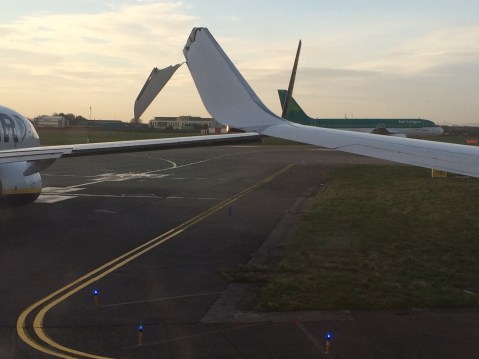
I was on a flight recently from Dublin and as the above photo shows, there was a little incident on the taxi to takeoff. Two aircraft touched each other. The one I was on (above) incurred wing damage, the other one tail damage. I’m not going to try to guess who made a mistake, but someone did. So what did this mistake cost?
Let’s think of costs in a broad sense. Here is my thinking
- Repair costs of both aircraft
- Lost revenue as aircraft are out of service
- Cost of renting replacement aircraft and crew
- Cost of emergency services attending the incident
- Customer service costs e.g. passenger refunds
- Cost of buses to return passengers to the terminal
- Increased compliance costs to ensure such mistakes do not happen again.
And there may be more. I’m just using this incident as an illustration of how we need to think of costs in a broad sense.
The cost you add to a flight – yes, you.
The April 2015 edition of National Geographic includes a very nice short article which draws on the work of two MIT aeronautical engineers. The article to me is a very nice mix of explaining why airlines charge more for more weight (of bags usually, but some airlines are considering weight of passengers too), and how we as passengers can reduce CO2 emissions as we fly.
For many years now, low-cost carriers in particular have charged more for checked in bags. They also step-up the charges as bags get heavier. The key reason for this is to reduce ground-handling time – less checked bags, less baggage handling, faster turnaround, all of which reduce cost or increase revenue. But, as the National Geographic article also points out, more weight equals more fuel consumption and higher fuel cost. The MIT engineers used a Boeing 737-800 (as used by Ryanair) at 75% capacity as a model to calculate how much extra fuel cost various passenger items incur over a year. A 25kg suitcase increases costs by $3,267 per annum, a 1okg carry on $980, a laptop $291 and a full-bladder $29 – among other examples. Ryanair currently have 303 aircraft (per their website), so taking just the costs I quote, this is $4,567 per passenger per year x 190 seats x 303 aircraft, this equate to $262,922,190 – and that’s a big potential cost saving. I can already see Ryanair’s next advert 🙂
There are two points to take from the above. It is obvious that airlines may charge more for weighty items as these drive fuel costs up. The second point is look how much cost we could save the environment by taking even small steps like taking a pee before boarding – $29 x 190 seats x 303 = $1,669,530 worth of fuel. This is just one airline, and I have no idea how much CO2 emissions are reduced by, but as Tesco say “every little counts”.
Some interesting small facts on the accounting profession
Here is a great little blog post I came across a few months ago. It’s a bit of fun, and worth a read.
Accounting for Bitcoin

We have probably all heard of the digital currency Bitcoin – there are some others but Bitcoin is the best known I think. I read a nice article on the Bitcoin magazine website recently which reminded me of the basic things us accountants need to consider if dealing in foreign currency or if a new currency comes along – it is not that long ago since the Euro came our way.
The article summarises well the three steps I experienced when operationalising the Euro more than a decade ago now. Like Bitcoin, the Euro was for me then a non-physical currency to begin with. The first “step” with the Euro and actually happening now with Bitcoin is use as a payment method. With the Euro, we had the ECU as a payment method first. In this case, the accounting entry is the same as any other payment method – such as a credit card or PayPal – all amounts are in local currency. Step 2 would be to treat Bitcoin as a foreign currency. In my experience this typically happens when volumes of payments to/from customers/suppliers become larger. For example, many Irish SME treat GBP as a foreign currency in their accounting systems, but treat the USD more like a payment method. As the articles notes, if Bitcoin is treated as a foreign currency then exchange gains and losses need to be accounted for. Step 3 is adoption as a base currency. This may not happen of course, only time will tell. Let’s assume it does happen, then the accounting system works pretty much the same as in step 2. The would also be some work in translating assets and liabilities to the new currency. With the Euro this was relatively simple as fixed exchange rates were agreed and then it was matter of running a routine within the accounting software to do the calculations.
As the article suggests, more businesses are accepting Bitcoin (as its stabilises in value) and thus are at step 1.
Apple’s numbers
As you may know, profits at Apple for Q4, 2014 were some $18billion. This is reportedly the largest quarterly profit in history.
One of the things accountants often do is use ratios to compare businesses from one year to another and with other businesses. With such a large profit at Apple, I’d begin to think that any comparisons might not be of great value. So is there any way we could our such a number is perspective. Certainly Apple could probably clear all Irish sovereign debt with there cash pile, but here is an interesting presentation from the BBC
The Pope’s view on accountants

Image from wikipedia
A recent quote from Pope Francis to the World Congress of Accountants captures the broader role of accounting quite well:
” everyone, especially those who practise a profession which deals with the proper functioning of a country’s economic life, is asked to play a positive, constructive role in performing their daily work, knowing that behind every file, there is a story, there are faces.”
This quote reminds us that behind the numbers are real jobs, real people and real effects. It may be easy to forget this as you trawl over a ledger audit trail or provide information to managers, but reminding ourselves of the broad reach of our accounting numbers can only be a good thing.
The full text the address by Pope Francis can be found here.
Why does craft beer cost so much?

Image from brubrewery.ie
I’ve often wondered why craft beer costs more than our normal mass-produced and popular brands. Is it because it tastes better – like the Bru brand to the left, it’s really nice. Or because it cost more to produce? Or the smaller breweries have less economies of scale? Or does tax have something to do with it. It may be a combination of all of these, or some other factors I have not mentioned. However, a quick search of the internet revealed the answer to me – it is about cost of production, but not the raw materials. It is also about volume, but not volume sales.
An article I found on the Huffington Post is a good example of the cost issue faced by craft brewers. If you look at the article, you will see that largest cost item is packaging – the bottle and label you may think. A bit of further digging around the internet revealed that the greatest part of the packaging cost is shipping. But not shipping to end customers, shipping to be bottled. It seems a bottling machine is quite expensive, and at small volumes is not easy for a craft brewery to purchase. Instead, they often send the beer away in vats to be returned in bottles. The Huffington Post article suggests that 50% of the cost to the customer is margin. I am not sure if this is the case in Europe, but certainly small craft breweries are unlikely to be able to invest in a large bottling plant at the outset. As volume increase, they may be able to do so. Let them stay small I say, the variety of beers is better then.
The costs of sitting in traffic?
 We all know what it is like to sit in traffic, but ever wondering how much money is wasted through lost time? An article from The Economist gives a good picture. Some research conducted by the Centre for Economics and Business Research and INRIX looked at costs of traffic jams in three ways – 1) reduced productivity, 2) higher transport costs and 3) carbon costs of fumes. Their cost estimates across four countries comes to some $200 billion. Quite a sum I think you will agree. I wonder how much of this cost relates to lost labour time – or in other words what is the opportunity cost to firms of having staff delayed in traffic. Of course, you could think of this from the view of the worker too – the opportunity cost might be at least some extra time in bed instead of the morning rush hour.
Trains in the west of Ireland – price and volumes.
 I read an article in a leading Irish newspaper recently which has a typical cost volume profit theme underlying it.
The article related to the “Western Rail Corridor”, a route from Sligo to Limerick which had been closed down many years ago. In recent years with the help of local campaigns and some political backing, some of the line re-opened. According to the article:
“A report by consultants drawn up before the service began concluded that, even with healthy passenger numbers, it would not be able to wash its face and would need hefty subventions. And the passenger projections in that report were substantially higher than those that actually travelled in the first few years”
It seems the passenger volumes have been quite low in recent years too. But then Irish Rail did something – they lowered fares and made tickets available online. With online fares as low as €6, the passenger number have increase from 23,000 to 41,000 in the year to November 2014. I do not know what the operating costs are, or whether these passenger numbers are sufficient in the long term, but it is a classic example of the relationship between price, cost and volumes. Assume the costs are the same at 23,000 or 41,000 passenger levels, the rail company is likely to be better off – maybe not making a profit on the route, but at least covering more of its costs.
Management accounting during WW1
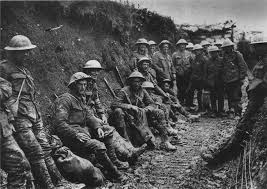
Image from wikipedia
As you know I’m sure, 2014 was 100 years since the outbreak of the Great War, or World War 1 as we know it today. Myself and a colleague were lucky enough to do some research on how management accounting was affected by the war. I will summarise our work here, but you can find the full paper here.
We studied how the war affected management accounting at Guinness – yes the world-famous stout. I had already carried out some research at Guinness, so I was aware that even before 1914 they had a relative complex management accounting system. They were quite good at allocating costs to various cost centres.
As the war broke out, the accountants and managers initially viewed it as a short-term event. It became apparent soon enough that would not be the case. Thus, Guinness started to view additional costs (such as extra insurance costs) as normal costs and allocated them to various cost centres. For example, if Guinness shipped to Liverpool or London, the freight costs were normally charged to the receiving depots owned by the company. With the war in full swing, the additional insurance costs for these trips was also allocated to the depots.
The company made other changes too, but the above example is a good case of existing practice being modified to deal with new business issues- something which management accountants still do a lot of today.
What does off-balance sheet mean – Vatican off-balance sheet cash

Image from wikipedia
In December 2014, the media (see here for example) noted how millions for euro were “off-balance” sheet. According to reports from the Vatican “some hundreds of millions of Euros were tucked away in particular sectional accounts and did not appear on the balance sheet”. So how can this happen, and what does off-balance sheet actually mean?
Let’s go back to basics first. A balance sheet shows assets, liabilities and equity. Assets are essentially something an organisation own’s or has use of like a owner; a liability is a claim against the business. Both must be measurable in monetary terms. So for example, many large firm’s brands have values in $billions put on them, but these are off-balance sheet assets which are off-balance sheet because the value cannot be measured accurately in money terms.
In other cases, such a the Vatican example, assets can be seemingly omitted from the balance sheet. This is of course not a recommended practice. How is this done? Well, it is a little bit more complex than this, but essentially something is omitted from the books of the organization. Remember, now matter how complex an organization is, underneath its accounting system is the good old double entry system of accounting. If a transaction (e.g. bank account) is omitted from the double entry accounts, that’s it, it does not appear on the balance sheet.
Accounting for water

Image from wikipedia
I have recently been involved in a research project on the newly formed Irish Water – a state-owned utility responsible for water supply in Ireland. The main objective of the new utility is to provide a unified approach to water supply – as opposed to the 30 odd previous authorities. While the utility has caused much media attention, this post draws your attention to the use of accounting principles in the provision of water supply.
Let’s think about water as a resource, which it is. Now think about the utility. It needs to account for the water it processes, distributes to customers and looses through leaks etc. To do this it needs various measuring devices such as meters. So, in a similar way to a ledger account, we could think as water coming into a system as a debit, water out a credit, the measurement is in litres (not money) and we should be able to account for the difference i.e. the balance on the account.
Now think about the end consumer of water. Similarly water comes in and out – the latter being usage. With meter installed, we can account for our usage, possibly trying to reduce usage. Or we can seek an alternative (partial) source of water by harvesting water from the roof of our house. By accounting for our usage, ultimately we can make decisions to reduce usage if we have to pay for the water resource. Without the ability to account for our usage (through a meter), we cannot make such decisions. This is of course more like management accounting – using our information on water usage to make decisions – but it is still accounting.
Opportunity cost – Gangnam style!

Image from guinnessworldrecords.com
You have probably heard of Gangnam Style, – if not click here. Anyway, it broke Youtube’s counter in December and now has over 2.1 billion views. The video runs at just over 4 mins, which is 140 million man hours. Some writers at the Economist took a nice angle on Gangnam Style – the opportunity cost of us all watching it. You can read their post here, but can you believe we could have built 20 Empire State buildings, built 3 aircraft carriers or written the entire contents of wikipedia 1.5 times. It’s certainly an interesting take on the time we could have used to do better things.
What’s the cost of Christmas?
Ask any parent and they will tell you a lot! Given the time of year, have a look at this article which looks at the costs of the 12 gifts in the “12 Days of Christmas” song we all know.
Have a great Christmas!


 Martin's accounting blog