Use of learning curves in real-life

If you studied management accounting in the past, do you remember this formula:
Y=tXl
Y= average hours to produce product, t= time to produce first unit, X= cumulative units produced and l= rate of learning.
Of course, you don’t remember this – it’s the formula for a learning curve. A what? A learning curve, which is the relationship between the time taken to complete a task as an employee learns how to do the task. Management accountants learn this formula as it can be used to predict how costs might behave when production tasks are changed or new tasks introduced. I have to say I have never had to use a learning curve in my time in industry, and forgot the formula until I had to teach it to students again in recent years.
A CIMA research report recently shed some light on the use of learning curves. According to the research, about 6% of respondents to a survey actually used learning curves in some way, but a vast majority of management accountants considered the technique appropriate for the organisation they worked in. What’s interesting is that the main reason for not using learning curves is a lack of knowledge on the part on management accountants. I suppose this does not surprise me as if you don’t use any particular accounting technique, you’ll quickly forget it. Which is exactly what I done! Until now that is. The research report does not give detailed findings on the specific uses of the learning curve, but top of the list of uses in planning/budgeting and costing of products/services.
Risk management and management accountants
 The idea of accountants taking risks tends to go against the stereotype image that accountants get – you know, grey suit, drives a Volvo and so on. Businesses take risks everyday, based on information available and sometimes on experience or gut instinct. Management accountants provide a lot of the information needed by managers to make decisions on a daily basis. One wonders though what happened to assessing risk in banks in recent times. I am reading a book called Downfall by Joseph Stiglitz at the moment and he sure has a lot to say about the lack of risk assessment by US (and European) banks on recent years. In one passage he talks about how banks assumed the risk of other banks failing, or of a property-crash were seen as minimal. But look what happened.
I read a piece back in January in CIMA’s Insight on risk management and management accountants. The key message from this article was that management accountants need to get the message across about risk. They are after all providers of information for decision making, and are training in risk management. As noted in the piece, defining exactly what risk is is not that simple. It seems risk managers may not have been overly involved in decision-making at high levels in recent times. The author suggests that risk managers and managements accountants work closely together to get the message across about risk. I couldn’t agree more. Management accountants may have shook off the dull, boring stereotype and are now often part of the management team and/or board. Thus, as the article suggests, risk managers might piggy-back on the organisational knowledge of management accountants and get active in the areas where risky decisions are being discussed or taken – i.e. at board level.
What is the prudence concept?
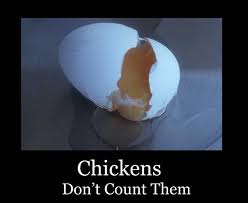 The prudence concept is another fundamental accounting concept. It basically means we count count our chickens before they hatch. In other words, when presented with options, the prudence concept would dictate we err on the side of caution. In practice, this means we should not overstate income, understate expenses, over-value assets or understate liabilities. To give an example, inventory is valued at the lower of cost or net realisable value (which is more or less what something sells for). While there are detailed accounting rules on inventory valuation, this is an example of the prudence concept at work. So, if the net realisable value was less that cost, inventory would be stated on the books at below cost. Another example is providing for bad and doubtful debts. For example, a business might think 2% of its customer debt will not be paid. This might not actually happen, but it is prudent to assume it will.
What is the accruals concept?
 Okay, in my last post I explained the entity concept. Today, it’s the turn of the accruals concept. The accruals (or matching) concept is probably the one that most accounting students come across so often. It also underpins quite a few of the complex accounting standards. So what does the accruals concept entail?
The matching concept is probably a better name for it, as the accruals concept is all about matching costs and revenues. When cash comes in from sales, or is paid out for costs does not matter. Let me give you an example. Assume a business has a delivery van which cost €20,000 and will be good for 5 years. This means it helps to generate revenue (by delivering goods) for 5 years. The accrual concept would dictate that the cost is matched against the revenue generating capability. So, even if the van were bought and paid for right now, the cost in the accounts would be €4,000 per year for each of the five years. In this way, the cost is matched against revenues over the same time frame. Here’s another real life example. How do you think an airline like Ryanair accounts for its’s revenues? You buy the ticket weeks or months in advance, so can they record the sale once you pay? The answer is no, as no cost has been incurred. Once you fly, the cost is now incurred and the revenue (sale) can be recorded in the accounts, even though the cash has been paid in advance.
Watch out for more on the basic accounting concepts soon!
What is the entity concept?

If you are learning accounting for the first time, one of the earlier things you should learn are basic accounting concepts. These are underlying rules which apply to accounting no matter how simple or complex the business or (to the best of my knowledge) the location.
One of these concepts is called the entity concept. In accounting, financial statements (e.g. income statement, statement of financial position (balance sheet)) need to be prepared for each business entity or group of entities under common control. When we think of large companies this is probably a simple enough concept to grasp. Companies are by nature separate legal entities too, and costs and revenues for each legal entity are normally easy enough to identify. In large groups, the entities are combined to prepare financial statements for the group as a whole. When we get down to the typical one-man-show type sole trader, things can get a bit blurred. But, the sole trader is probably the best example to explain the entity concept. For the sole trader, the entity concept would dictate that all business and personal expenses must be separated. Here’s an example. Let’s say a sole trader makes a business trip which means an overnight stay in a hotel. Let’s assume his/her partner comes along. Should any costs associated with the partner be treated as expenses in the sole trader’s accounts? Of course, the answer is no. (But hotel rooms often cost the same for 1 or 2 persons you’re thinking – so make sure your partner’s name does not appear on any bills for the room!). I remember another example from my time in practice. Following a tax audit, the tax inspectors correctly disallowed a repair to a washing machine as a business expense. This would only be an expense in a laundrette or similar business.
So the key thing to remember about the entity concept is to isolate the business entity and only include costs and revenues associated with that entity. Any personal costs/revenues should not be included. Costs/revenues of other entities should be excluded in general too (unless you are looking at a group).
Key metrics for your small business
 In management accounting, we often talk about Key Performance Indicators (or KPI). These are measures of business performance which catch the essence of how a business is doing. Choosing the right KPI is not an easy task, even for a business with accountants on the payroll. This leaves it tough on smaller businesses, who probably have little expertise in this area. Having said that, there are a number of key things you might focus on as a small business.
The first is cash, without it you are snookered. Accountants often refer to liquidity issues, meaning a business cannot generate enough cash. Liquidity issues lead to solvency problems, meaning you can’t pay debts as they fall due. Traditionally, accountants will tell you need the ratio of cash and receivables to payables to be about 1:1. To make this sort of metric even easier, why not think about it like this:
Cash in the bank/Monthly cash requirements = number of months until cash runs out.
You could easily work this measure out at any time and try to collect debts from customers before you run out of cash. If you have a bank overdraft which is within its limit, you could quickly alter the above to figure out how long until you hit the overdraft limit.
A second key metric is your cost structure. You could regularly compare you costs as a portion of sales revenue. Keeping a tab on this might help prevent cost overruns over a period of time. So if you see sales drop off, are costs remaining the same?
Finally, think beyond the traditional financial measures. Try to think of what it is that keeps your business ticking over. The key metric(s) here will vary by business but you should consider things like:
- number of new sales enquiries
- number of customer complaints
- how efficient is your production and/or purchasing
- what’s your market share.
- sales revenue by customer/product or segment


 Martin's accounting blog