Ireland’s low corporate tax rate – good or bad?

(Photo credit: Wikipedia)
I wrote this post as a guest post for my fellow blogger Mark Holtzman (see accountinator.com)
Many of you are probably familiar with Ireland’s low rate of corporation tax – 12.5%. It has been the subject of many articles and much criticism over the years and in recent times – articles including companies such as Google and Facebook and terms such as “the Dutch sandwich”. So, for the benefit of anyone outside Ireland, let me try to explain a few things and give my opinion for what it is worth. By the way, I am no tax expert.
Ireland is a small island with little or no natural resources – except our scenery and Guinness perhaps. As a result, we have never had any serious indigenous manufacturing. Thus, at some point in the 1970’s a 10% corporate tax rate on manufacturing was introduced. All other businesses paid a higher rate, which I think was 33%. I remember learning tax in college and with this difference in rates, some companies stretched the definition of manufacturing. There was one case I recall which involved determining whether or not banana ripening was manufacturing. The courts ruled in was and since then, is the largest banana exporter in Europe. It’s true, and no banana republic jokes ! The outcome of this case resulted in a large infrastructure being developed in the country for banana ripening.
Now, our corporate tax rate is 12.5 % for all business. So we cannot say Ireland is a tax haven – as all companies are treated the same. But it is fair to say we are a low tax economy. Our European neighbours (Germany in particular) complain, and there are many reports on large US companies avoiding US taxes by being based in Ireland or using Ireland’s low tax rates to transfer profits through Ireland. So is this good or bad? Well, there is no correct answer to this, and of course the answer depends on your perspective. From my perspective as an Irish person and accountant, it is good – jobs are created, more taxes are brought in than if the rate were higher for example. The German government don’t seem to like our low tax rate – their rate is higher apparently – and there are rumblings to have a more common Europe wide tax rate.
But are low tax rates good? Perhaps they can be. Last year when our government was preparing its budget one economist showed that and 11% rate of value-added tax (like a sales tax) would yield the budget deficit. The current VAT rates are 23%, 13.5%, 9% and 0%. – depending on the type of good or service. If all this was replaced with a single 11% rate, an annual additional intake of €1.5 billion would occur assuming demand was stable. Another idea on low tax rates is that if the rate is lower, more people will pay – or put it another way, less will avoid it. In the 1980’s our income tax rate topped 60%. Small business in particular hid money in off-shore accounts. By the early 1990’s, the top rate had decreased to 48% (now 41%). The tax authorities had a tax amnesty, whereby heavy penalties and interest were waived on the off-shore monies. This, and the lower tax rate, brought many thousands of people into the tax net. And as the tax rate has stayed lower than previous times, these businesses have by and large stayed in the tax net and the black economy is less than previous.
A final point when comparing tax rates is what do we mean by tax. For example, all businesses in Ireland pay very expensive rates to the local council/municipal authority. In other countries, this is much less. For example, certain German states keep their local taxes low to attract investment. So before comparing headlines tax rates, we have to ask are we comparing apples with apples. As any management accounting student knows, we cannot compare figures which are not comparable as a basis for decision-making.
I hope you find these thoughts useful. I have included some links below which may be relevant.
Related articles
- Editorial: Cut corporate taxes to bring business back (ocregister.com)
- Be Glad You’re Not Living in One of the Those Terrible High-Tax Countries (irishleftreview.org)
- U.S. Tax Rates Are Really Low (washingtonmonthly.com)
- Insight: In Europe’s tax race, it’s the base, not the rate, that counts (Reuters) (newsdaily.com)
That’ll be €1500. Can I pay in cash? Sorry sir, no.

Cash (Photo credit: BlatantWorld.com)
During the summer, I was on holiday in Sud Tirol (it’s Italy, but the culture is more Austrian). We were led to our room, shown around and then asked how will we pay when we leave. The reason for the question was that a law introduced as part of Italy’s austerity measured prevents cash payments in excess of €1,000. Now, I never carry much cash, but I was thinking what an odd law. Is it to stop tax evasion? Apparently so. I read around a bit and found that Spain also has a similar law. And apparently the Italian’s actually wanted to implement the law with a lower amount.
Now, as an accountant I completely understand the issue of tax evasion, cash deals and the black economy. But where is this headed? When I done Business Studies in secondary school, I remember being thought the concept of legal tender. Pre the Euro, the Irish Punt notes were legal tender for settlement of any amount and apparently this may be still so (see here re Euro legal tender). If cash cannot be used at all, what happens when the banking systems fail? Don’t anybody tell me they can’t/won’t; see my post soon on Ulster Banks’ systems failures this summer. And if I were to get a bit political, are we perhaps in the future to trust the very banks that brought the world a financial crisis to manage all transactions. Yeah, I’m being a bit over the top perhaps, but I completely disagree with strict cash controls. There must be other ways to make businesses more tax compliant e.g. focused audits, serious penalties.
Cleaner transport (and cost savings?)
 Back in February this year I wrote a short post about how Tesco were increasing their use of rail travel to reduce CO2 emissions. It was a good example of how to change your business to both deliver cost savings and be more environmentally friendly. In the February 2012 edition of CIMA’s Financial Management (pp 26.30), there is a great article written by Ben Schiller which provides a number of examples of firms which are seeking ways to reduce transport costs and CO2 emissions. One quote from the article sums up the problems around transport costs “many ships operating today were built to run on $150 a tonne bunker fuel, not a price four times that”. Of course, it is not only ships but all forms of transport which are facing these price increases, such as road haulage and even company cars (for example, when I bought my first diesel car just over 3 years ago, diesel was 99 cent per litre at my local station, now it’s over €1.50). As a result of these increasing costs, we can see more sleek looking fuel-efficient trucks for example on our motorways.
I found Ben Schiller’s article really great less for some examples we might know about – chip fat being converted to biodiesel, electric vehicles – but more for some real examples from firms we all probably know well. The first way firms can save on transport costs (and green up) is to bring production closer to the market – L’Oreal for example have brought some of their supply chain in-house, by producing thinks like packaging on-site. A second way, is to change the modes of transport. For example, both Philips and Tesco use canals to transport bulky product. Phillips use barges to transport goods to Rotterdam port, while Tesco ship wine between Liverpool and Manchester. In Spain, SEAT rebuilt a short rail line to Barcelona port, carrying 80,000 cars annually using 2 trains a day. Even large shipping companies like Maersk are doing things like “slow-steaming ” (or sailing slower) to reduce CO2 emissions and fuel costs.
There are more examples in the article itself. You can read an online summary here.
Driverless cars?
Not my normal topic, but have a read of this news piece on the BBC
Now driverless cars have been around for a while, but what will Google do, pop up ads to make money as you drive by somewhere ??
Can social data change markets?
In recent years, we have heard so much about the (financial) markets, their reactions, lack of confidence and so on. I often feel like asking who or what exactly is “the markets” and will they ever just leave us alone. The economist Adam Smith used the analogy of the invisible hand, a self correction mechanism the markets may have. More recently Chandler alone of the visible hand – the firm – which could be influenced and changes perhaps easier than something like an invisible market hand.
I’m no economist, but I do find this stuff interesting. Especially nowadays when you think if the amount of information a firm could have – social data for example. I read an article in a Forbes blog last year some time, which suggested the prevalence and increasing availability of social data might be the invisible hand that could change markets, or at least help us to understand the markets. Seems like an interesting thought – click here to read the post.
Peer-to-peer lending – a source of finance for small business?
 I read an interesting article in the November 2011 issue of Financial Management, CIMA’s monthly journal. The topic was peer-to-peer finance, which was something I had only heard a little about. Given the combination currently of low deposit interest rates and high lending rates for small business, peer networks have formed and are seemingly growing fast. The basic idea is relatively simple: some business have cash surpluses and others need finance – but not at 19% (which was a rate quoted to one business mentioned in the article). Those with spare cash can group together and lend to those that need it. The risk may be lower for the provider of finance as only a small amount can be contributed, and for the borrower the rate is lower (8.9% in the case of the business the bank wanted 19% from). Two peer-to-peer lending networks are mentioned in the article – Thincats and Funding Circle. In effect such networks are like mini-money markets. They do, of course, undetake some credit checks and crediting rating, but for small business this seems to be a very sensible way to bring borrowers and lenders together.
Prices, costs and business failure – a few examples from Ireland
 In recent years hard economic times have hit Ireland and other developed economies. According to an article in the Guardian over a year ago now, the number of businesses failing in Ireland was 5 times that in 2010 – a huge chunk of these being construction firms. I hope have some sympathy for many of the hard-working business people who perhaps have seen a lot of their money lost. But, there is a part of me (probably the accountant) who is not at all surprised at so many Irish businesses failing. Why? Am I getting more cranky (Yes, of course I am)? Well, let me give me a few of many examples I have encountered over the last few years which seem to show poor decision making. But before I do, I should say that many Irish businesses who started during the “boom” years were already doomed to failure due to a pretty high cost structure e.g. rent.
The first example dates back about 2-3 years now. In the area where I live, we collect an amount of money each year to help maintain the common greens in the area. The landscaping business doing the work was charging about €7000 per annum and a new landscaper offered to do the work for €4500. Both were sole traders with similar costs (as best I could guess at least). The original landscaper said he could not do the work for that price and would not even reduce his current price, so the business was lost. Now I don’t know what either landscaper was thinking, but it fairly obvious that the original landscaper was living in the boom years in my opinion. He could have reduced his price by some amount, say €1500. This would mean his net contribution would fall by €1500, but instead he lost €7500 – a bad decision.
The second example relates to a really nice bakery I visited recently in a more affluent part of Dublin. Yes, the price is of course going to be affected by the area, but having paid €4.60 (ok my wife bought it) for a loaf of sour-dough bread I thought this is not a sustainable business. Even people in affluent areas cut back on spending in lean times. The point here is that I thought the price was more reflective of a time four or five years ago.
The third example relates to an employee within a business. The employee left as €900 per week income was not “enough” for him. The job involved manual labour and some skills, but nothing that could not be replaced readily. The right decision was made by the business owner, which was adiós amigo. The employees decision was rather silly though, as the immediate income from social benefits would be way lower.
These three examples to some extent portray how high prices may have become engrained in the minds of business people following many years of the Celtic Tiger. I like to study how practices have become accepted/taken-for-granted, or institutionalised. When practices become institutionalised, there are hard to change. So I wonder are businesses in Ireland failing because some business owners cannot make the change in their minds to reduce costs or prices? In other words, they are finding it hard to break the institutionalised practices associated with past more affluent times. I know there are many other factors, but based on my experience, at least some business failures in Ireland result from a failure to change mindset.
How business models can (climate) change
 Following on from my last post on what is a business model, here I recount two articles I had saved from last year on how climate change can force businesses to change – and in some cases even change the business model.
The first article comes from Time (Sep 04, 2011). It recounts how Spanish winemaker Torres are increasingly moving their crops to higher, cooler areas of Spain. Due to global warming, the hotter climate means sweeter fruit and earlier ripening. At the same time, the early ripening of the fruit is offset by the fact that the seeds and skin (which give flavour) are not ripe. Thus, as a possible solution, vines are being planted at a higher, cooler altitude in an effort to offset the warming experienced in traditional regions.
The second related article comes from The Economist (Sep 10, 2011, online). In this articles, you can read how English wine is being produced in increased volumes and better quality – with locally grown grapes. Again, it is climate change – bringing warmer climes to Southern England – meaning that more traditional grape varieties can be grown in England as opposed to the typically acidic German varieties. The result has been a product of increasing quality, and a tendency to produce higher margin sparkling wines – something that was not so easily done before. Thus, the business model of English vineyards may have changed from one where imported “grape juice” was added to make local wine, to one where high quality, high-margin product is the norm.
Dealing with a currency crisis/hyperinflation – a quick historical note and IAS29
 Over the years, economies have suffered many currency crises, soaring interest rates and hyper-inflation. Luckily, in my time as an accountant I have not had to deal with financial statements or other accounting information where the value of money became, well worthless. Runaway inflation for example occurred in Germany in the 1920’s and today it is still present in countries like Zimbabwe. In times of hyper-inflation, accounting standards do give us some guidance. IAS 29 suggests hyperinflation may have several characteristics
1) the general population prefers to keep its wealth in non-monetary assets or in a relatively stable foreign currency. Amounts of local currency held are immediately invested to maintain purchasing power;
2) the general population regards monetary amounts not in terms of the local
currency but in terms of a relatively stable foreign currency. Prices may be quoted in that currency;
3) sales and purchases on credit take place at prices that compensate for the expected loss of purchasing power during the credit period, even if the period is short;
4) interest rates, wages and prices are linked to a price index; and
5) the cumulative inflation rate over three years is approaching, or exceeds, 100%.
Without going into too much detail on IAS 29, when such hyperinflation exists, the financial statements have to be restated to a monetary value using some form of price index.
I recently had the good luck to see real financial statements prepared during a hyperinflation period. The accounts were if a German brewery and dated back to 31/12/1923 – long before IAS 29 was even thought about. The inventory figure had 18 digits, which I think is called a quintillion. I cannot imagine what it must have been like to deal with figures like this. Mind you the kinds of figures being thrown around nowadays on sovereign debt are getting close to these kind of numbers. Just out of interest the accounts on 1/1/1924, showed a figure of about 2 million marks – a new mark was issued and pegged to gold I think.
Germany’s Finances Not as Sound as Believed
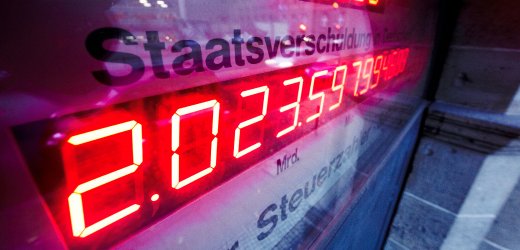
I could not help but share this. It’s a kind of “get your own house in order first ” message.
Flawed Role Model: Germany’s Finances Not as Sound as Believed – SPIEGEL ONLINE – News – International. (Image from Spiegel Online)
So are we (Ireland) getting it right……
 A small delve into economics, sorry. I read this article on the Wall Street Journal about my homeland (well, my dear home too!) and it make me think, well, we not total gobshites! Of course, we’re not, no matter what Fr. Jack (left says!). But in all seriousness, I can’t help but compare what the articles says to my own experience of talking to and helping small Irish businesses. I don’t know anyone who is not worried about the future of their business, but yet they all pulled-up their socks and did what any management accountant would advise – look at your costs, your processes, what you do and so on. I know two businesses who realised they needed to work 3-days weeks for almost a year, but they are now fine again. Others dropped price, or just worked smarter. I also can think of others who just would not adjust their cost structure, prices, staff or anything. Where do you think these guys are? Well nowhere simply. Of those businesses that adapted to survive, they have learned a hard lesson on cost structures, doing things well, adjusting price and looking after customers. Those, like the WSJ article say about Ireland, will be the stronger firms in the future ( I hope ).
Some “practical” economic indicators
Here’s an interesting blog post marking 25 years of the Big Mac index – http://www.accountingweb.co.uk/blog-post/mac-roeconomic-indicators
Pension problems
I don’t write very often about economics and politics- not really my thing. However, while on holidays I read a great article in the Guardian about the on-going pension problem/debate in the public and private sector. Have a read, I think it is a great summary of the many issues with our future pensions. Here us the link http://m.guardian.co.uk/business/2011/jul/03/pensions-unions-government-young-sacrificed?cat=business&type=article
Who makes what for the iPhone, and how much does it cost
 As a management accountant, I’m always interested in what products cost to make. In today’s global manufacturing economy, it’s even more interesting as product components are sources from all over the world. Time [May 16, 2011] provides a great example, the iPhone. According to the article, the total cost of the iPhone 5 is $179. Of this amount, $61 goes to Japanese suppliers, $11 to US suppliers, $30 to Germany, $23 to South Korea, $7 to China [where the phone is assembled], and $48 goes to other unknown sources. Given that the selling price is around $500, this means that the loins share of the added value in an iPhone about, or $321, stays within the US company. I have to say I was surprised that China contributed so little to the final value.
A comparison of taxes and take-home pay
 Just a short post today, as I’m enjoying some holidays. We hear a lot about the relative amount of tax we pay (in Ireland) as a portion of our take-home pay. An article in the Economist of May 12 last puts Belgium at the top of the OECD countries in terms of how much of the total labour costs is taken in taxes and social insurance. It’s 55% in Belgium. Ireland is much lower at 29%. The UK stands at 33% and Germany at 55%. These figures are for single persons. Things change a little bit when you look at families, but not too much. This spreadsheet from the OECD’s website provides the full details. Take a look at “Tax Wedge overview” sheet in particular.


 Martin's accounting blog